

Water Ring Vacuum Pumps – JD Vacuum Service
Introduction to Water Ring Vacuum Pumps
What Are Water Ring Vacuum Pumps?
Water ring vacuum pumps (LIQUID RING VACUUM PUMP) are rotary positive displacement pumps that use water as the sealing medium. These pumps are widely used in industries where moisture, vapor, and gases must be handled efficiently.
How Do They Work?
A rotating impeller forms a ring of water inside the pump casing. This water ring creates chambers that trap and compress gas, generating a stable vacuum. Their simplicity makes them highly durable and easy to operate.
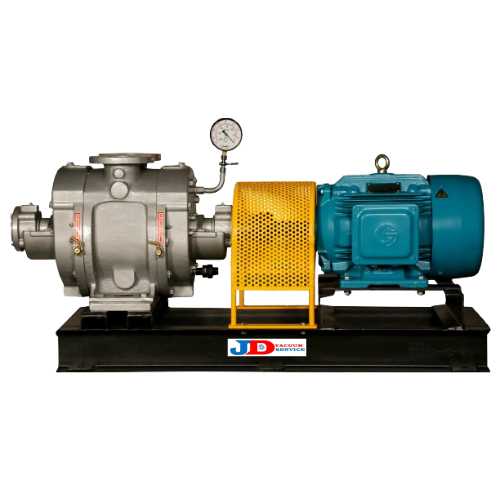
single stage water ring vacuum pumps
- Type: Single Stage Water/Liquid Ring Vacuum Pump
- Capacity Range: 50 m³/hr to 3000 m³/hr
- Ultimate Vacuum: Up to 710 mmHg
- Motor Power: 3 HP to 75 HP (Based on model)
- Material Options: Cast Iron / Stainless Steel
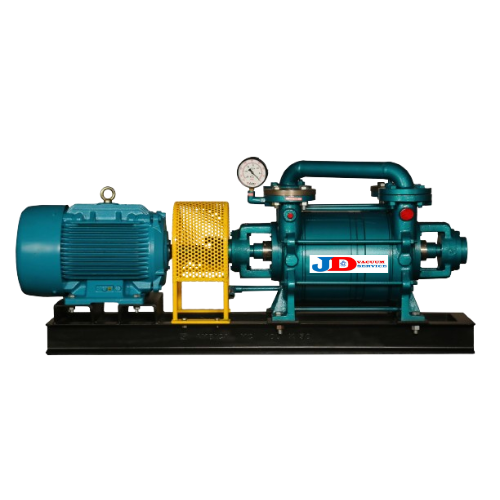
two stage water ring vacuum pumps
- Type: Two Stage Liquid Ring Vacuum Pump
- Construction: Cast iron / SS options
- Vacuum Range: Up to 29 inHg (varies by model)
- Capacity: Wide range from 50–3000 m³/hr
- Motor Power: 3 HP to 60 HP (model dependent)
Key Features
Corrosion-Resistant Design
Made with durable cast iron or stainless steel, these pumps withstand harsh environments and aggressive chemicals.
Smooth and Vibration-Free Operation
The water-based compression mechanism ensures quieter operation, making it ideal for sensitive industrial environments.
Low Maintenance Requirements
With fewer moving parts, these pumps require minimal repairs, reducing downtime significantly.
Efficient Handling of Wet Gases
Water ring vacuum pumps excel at handling condensable vapors, making them perfect for industries dealing with moisture-laden gases.
Advantages of Using
High Reliability
These pumps offer consistent performance even under challenging conditions.
Long Service Life
The robust design ensures many years of uninterrupted operation.
Energy-Efficient Performance
Water ring pumps consume less power compared to traditional vacuum pumps.
Safe for Hazardous and Explosive Applications
Due to their water-based operation, they produce no sparks, making them suitable for flammable atmospheres.
JD Vacuum Service – Your Trusted Vacuum Pump Partner
Premium Quality Manufacturing
JD Vacuum Service provides high-quality pumps built with precision engineering and advanced technology.
Customization Options
Every industry has unique requirements—JD Vacuum Service offers fully customizable pump configurations.
Professional Installation & Support
The expert team ensures proper installation, performance optimization, and long-term support.
Fast Delivery & After-Sales Service
Quick dispatch and reliable customer care make JD Vacuum Service a preferred partner.
Applications
Chemical Processing
Ideal for distillation, evaporation, and solvent recovery.
Pharmaceutical Industry
Used in vacuum filtration, drying, and packaging.
Food Processing & Packaging
Ensures hygienic operations and consistent product quality.
Textile Industry
Used for vacuum drying and moisture removal.
Power Plants & Distillation Processes
Perfect for deaeration and vapor management.
Types of Water(liquid) Ring Vacuum Pumps Offered by JD Vacuum Service
Single-Stage Pumps
Best for moderate vacuum levels with high efficiency. (710 mm/hg)
Double-Stage Pumps
Ideal for achieving deeper vacuum levels. (720 mm/hg)
Mono Block Water Ring Pumps
Compact and easy to install, perfect for limited-space applications. (710 mm/hg)
Technical Specifications
Capacity Range
Flow rates from 30 m³/hr to 1800 m³/hr depending on model.
Motor Power
Available from 1 HP to 75 HP.
Construction Material
Cast Iron, Stainless Steel, and special alloys for chemical resistance.
Vacuum Range
Up to 710 mmHg depending on the pump design.
Why Choose JD Vacuum Service?
Industry Expertise
Years of experience delivering vacuum solutions to top industries.
Quality Assurance
Each pump undergoes strict quality testing before dispatch.
Affordable Pricing
Competitive pricing without compromising durability.
Focus on Customer Satisfaction
JD Vacuum Service ensures every customer receives high-quality service and product support.
How to Maintain Vacuum Pumps
Regular Inspection
Check for leaks, unusual noise, and wear periodically.
Water Level Management
Maintain recommended water levels to ensure smooth operation.
Seal & Bearing Care
Lubricate bearings and monitor seal conditions regularly.
Cleaning Procedures
Clean the pump casing and pipelines periodically to prevent scaling.
Choosing the Right Pump for Your Industry
Factors to Consider
Evaluate vacuum level requirements, operating environment, and materials handled.
Flow Rate & Suction Requirements
Ensure the pump capacity matches your industrial processes.
Compatibility with Materials
Choose corrosion-resistant materials for chemical-heavy industries.
JD Vacuum Service’s Commitment to Excellence
Real-Life Success Stories
Many industries report improved efficiency and reduced energy costs after switching to JD Vacuum Service pumps.
Trusted by Top Industries
From pharmaceuticals to food processing, JD Vacuum Service has built long-lasting partnerships.
The following table provides a concise comparison of single-stage and two-stage water(liquid) ring vacuum pumps:
| Characteristic | Single-Stage Water Ring Vacuum Pump | Two-Stage Water Ring Vacuum Pump |
|---|---|---|
| Number of Impellers | 1 | 2 (arranged in series) |
| Vacuum Level Achievable | Moderate (up to 26-29 inHg / ~33 mbar abs) | Deeper (exceeding 29 inHg / ~0.5 mbar abs) |
| Efficiency at High Vacuum | Lower | Higher (especially above 23 inHg) |
| Cost (Initial/Maintenance) | Lower | Higher |
| Complexity | Simpler | More Complex |
| Typical Applications | Packaging, Food Processing, HVAC, Basic Laboratories | Pharmaceuticals, Electronics Manufacturing, Chemical Processing, Solvents |
Troubleshooting Guide for Key Issues
Reduced Pump Performance:
- Inspect suction and discharge lines for leaks or blockages.
- Check impellers for signs of wear or damage and replace if necessary.
- Ensure the seal liquid flow rate is within the recommended range.
- Monitor the seal liquid used and its vapor pressure, as changes can affect vacuum levels.
- Analyze original design parameters against current operating conditions, especially regarding gaseous composition and cooling water temperature.
- Confirm back pressure is as per design conditions.
Unusual Noises or Vibrations:
- Inspect the pump for signs of misalignment (belts or couplings) and adjust if necessary.
- Check bearings for signs of wear or damage and replace if needed.
- Look for signs of cavitation, such as pitting or erosion on the impellers, and address the issue promptly.
- Ensure proper pump mounting.
Overheating:
- Monitor the cooling water flow rate and adjust as necessary.
- Regularly clean heat exchangers to remove any debris or contaminants.
- Ensure proper lubrication of the pump’s bearings and other moving parts.
- Check for high inlet temperatures or clogging of the discharge port.